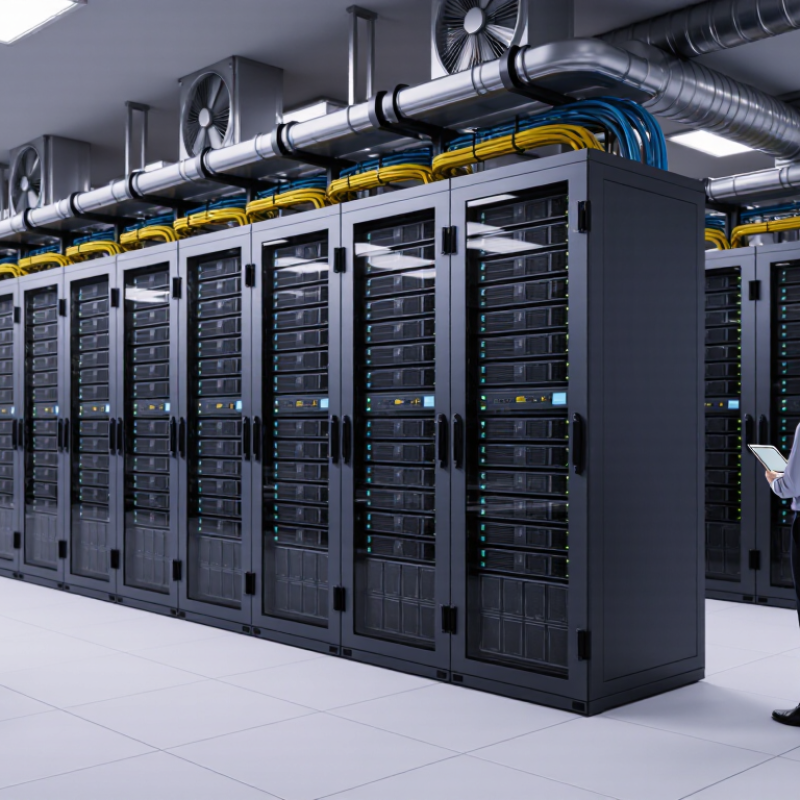
| AI Infrastructure Spending |
Global AI infrastructure spending is forecast at approximately $154 billion for 2024. |
AI servers, accelerators, networking, storage, and related infrastructure represent a large and rapidly expanding investment category. |
Choose a supplier with scalable production, lifecycle planning, and support for high-density AI platforms. |
IDC forecast cited in the market title |
| Data Center Energy Demand |
Data centers consumed about 415 TWh of electricity globally in 2024; demand is projected to more than double by 2030 in the International Energy Agency’s base case. |
Power availability and thermal management are becoming central constraints for AI deployment. |
Prioritize liquid-cooling readiness, efficient power delivery, thermal validation, and rack-level energy monitoring. |
International Energy Agency, Electricity 2024 |
| Cloud Computing Model |
The NIST cloud model includes on-demand self-service, broad network access, resource pooling, rapid elasticity, and measured service. |
AI capacity can be provisioned and measured as demand changes instead of relying only on fixed local hardware. |
Select hardware designed for remote management, telemetry, multi-tenant operation, and automated provisioning. |
NIST SP 800-145 |
| AI Workload Profile |
Training is generally compute-intensive and batch-oriented, while inference is commonly latency-sensitive and continuously service-oriented. |
One server configuration rarely delivers the best results for every AI workload. |
Use modular configurations that can be optimized for training, fine-tuning, retrieval, or inference. |
Standard AI infrastructure workload classifications |
| Elastic Capacity |
Cloud environments are designed to add or release pooled resources according to workload demand. |
Organizations can handle model-training peaks and inference traffic without permanently sizing every system for maximum demand. |
Look for standardized platforms, fast deployment procedures, and upgrade paths that reduce configuration time. |
NIST cloud computing characteristics |
| Network Throughput |
High-performance AI clusters depend on low-latency interconnects and high-bandwidth data movement between compute, storage, and network resources. |
Poor network design can leave expensive compute resources waiting for data or synchronization. |
Evaluate PCIe connectivity, fabric compatibility, oversubscription, cable layout, and network validation at rack scale. |
AI cluster architecture principles |
| Availability Target |
99.9% availability permits approximately 8 hours 46 minutes of downtime per year; 99.99% permits approximately 52 minutes 34 seconds. |
Higher availability targets require stronger component quality, redundancy, monitoring, and service procedures. |
Confirm failure-domain design, spare-part availability, diagnostics, firmware management, and repair response processes. |
Availability values calculated from annual hours |
| Power Usage Effectiveness |
Power Usage Effectiveness, or PUE, is calculated as total facility energy divided by IT equipment energy. A lower value indicates better facility efficiency. |
AI server efficiency must be assessed at both server level and facility level. |
Request measured power curves, thermal test results, airflow requirements, and support for facility efficiency programs. |
The Green Grid PUE methodology |
| Deployment Flexibility |
Cloud AI infrastructure may be deployed in centralized data centers, regional facilities, colocation sites, or edge environments. |
Different locations impose different requirements for rack depth, power input, cooling, noise, security, and remote operation. |
Choose a manufacturer offering configurable chassis, regional compliance support, and deployment documentation. |
Common cloud and edge deployment models |
| Total Cost of Ownership |
AI server TCO includes hardware acquisition, electricity, cooling, networking, software operations, maintenance, downtime, and hardware refresh costs. |
The lowest purchase price does not necessarily produce the lowest cost per training run or inference request. |
Compare performance per watt, utilization, service life, upgradeability, warranty coverage, and operational labor. |
Data center TCO evaluation practice |
| Lifecycle and Service |
AI platforms require coordinated hardware, firmware, driver, monitoring, cooling, and replacement-part management throughout their operating life. |
Reliable lifecycle support protects cluster availability and reduces the risk of inconsistent configurations. |
Prefer a manufacturer with documented validation, predictable component substitutions, remote diagnostics, and long-term technical support. |
Enterprise server lifecycle management practices |
 Zentraix