 Zentraix
Artificial intelligence is moving from experimental labs into production factories, hospitals, banks, and logistics networks. This shift makes inference infrastructure a practical purchasing decision, not merely a hardware discussion. Stanford University’s AI Index 2025 reports that the cost of querying advanced AI models has fallen sharply, encouraging wider commercial deployment. More applications now require dependable servers, predictable latency, and efficient power management.
The International Data Corporation (IDC) has also forecast strong growth in worldwide spending on AI infrastructure. That investment includes accelerators, networking, storage, cooling, and specialized server platforms. A capable ai inference server manufacturer must therefore offer more than high benchmark scores. Buyers should examine thermal design, accelerator compatibility, memory bandwidth, software support, security controls, warranty coverage, and regional service capacity.
Small details matter.
A server may process thousands of requests in a test environment, yet perform differently inside a crowded data center. Rack density, airflow, firmware updates, and model-quantization support can change operating costs significantly. The Uptime Institute’s data-center research repeatedly emphasizes resilience, power availability, and operational discipline as essential infrastructure concerns.
This guide evaluates seven manufacturers serving global buyers. It considers product maturity, deployment flexibility, support networks, and evidence from real-world enterprise use. The ranking is not absolute. Procurement priorities differ between a cloud provider in Singapore and a manufacturer in Germany. Some vendors appear stronger on performance, while others provide better integration or service coverage. That distinction deserves careful review. Reports provide useful direction, but independent testing and total-cost analysis remain necessary before signing a purchase order.
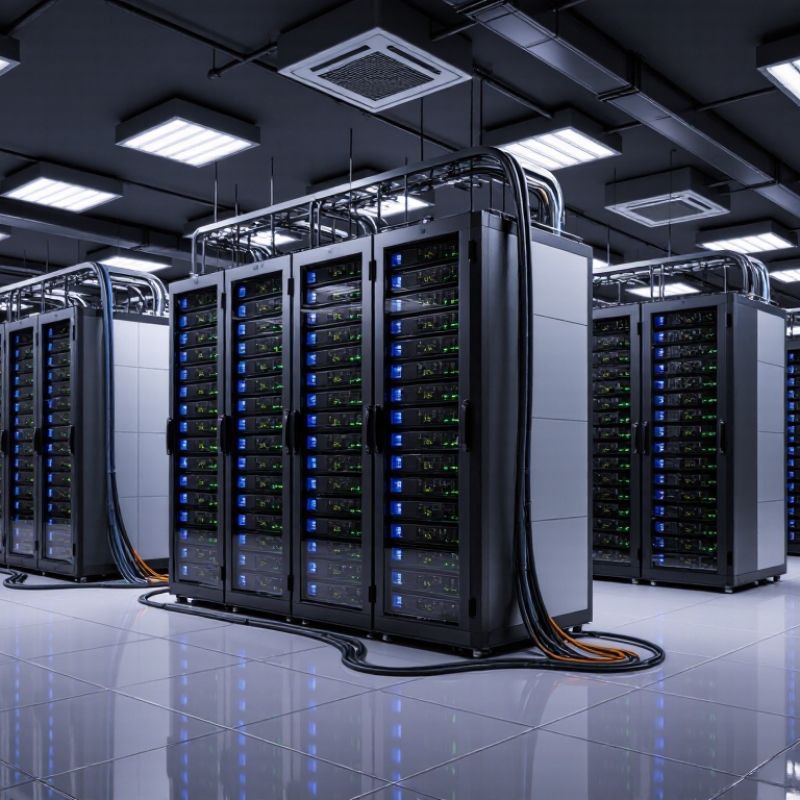
A standout AI inference server manufacturer understands that production performance is not measured by peak benchmark scores alone. It must deliver predictable latency, high memory bandwidth, and stable throughput under continuous workloads. Stanford University’s AI Index 2025 reports that GPT-3.5-level inference costs fell from about $20 to $0.07 per million tokens between November 2022 and October 2024. Efficiency now shapes purchasing decisions. Every watt matters.
Experienced manufacturers design for real data centers, not laboratory conditions. They provide thermal guidance, redundant power options, remote monitoring, and firmware updates across the server’s lifecycle. The International Energy Agency estimates that data centers consumed about 460 terawatt-hours of electricity in 2022, with demand potentially exceeding 1,000 terawatt-hours by 2026. Cooling design deserves equal attention. A fast server that throttles inside a dense rack is not truly fast.
Reliable vendors also explain their testing methods. Buyers should request latency results at different batch sizes, utilization levels, and model quantizations. Security features, supply continuity, warranty response, and integration support matter just as much as accelerator specifications. No specification is perfect. Real workloads change. A manufacturer that admits thermal limits and offers practical configuration advice often inspires more confidence than one promising unlimited performance. I would also inspect service records, because a delayed replacement can cost more than a modest hardware premium.
| Rank | Anonymous Manufacturer Profile | Primary Server Focus | Typical Accelerator Configuration | Inference Workloads | Deployment Options | Key Strengths | Global-Buyer Considerations | Overall Fit |
|---|---|---|---|---|---|---|---|---|
| 1 | Manufacturer A | High-density 4U and 8U GPU inference systems | PCIe accelerators Multi-GPU High-speed networking | Large language models, generative AI, image generation, speech recognition and recommendation engines | Enterprise data centers, private clouds and colocation facilities | High compute density, strong thermal design, redundant power options and flexible GPU expansion | Requires careful rack, power and cooling planning; suitable for buyers with established data-center infrastructure | Best for large-scale deployments |
| 2 | Manufacturer B | General-purpose 1U and 2U inference servers | Single or dual GPU PCIe expansion CPU inference | Computer vision, fraud detection, virtual assistants, analytics and moderate-size language models | Office data centers, regional facilities, edge locations and managed hosting | Balanced cost, compact form factor, easier installation and broad operating-system compatibility | Offers a practical entry point; confirm GPU availability, warranty coverage and local service capability | Best overall value |
| 3 | Manufacturer C | Liquid-cooled high-performance AI platforms | High-power accelerators Direct liquid cooling Dense configurations | Large-scale transformer inference, scientific computing, digital twins and real-time simulation | Purpose-built AI clusters and hyperscale-style facilities | Improved thermal efficiency, reduced air-cooling demand and support for high sustained workloads | Higher installation complexity; buyers need compatible liquid-cooling distribution and maintenance processes | Best for power-constrained facilities |
| 4 | Manufacturer D | Edge AI and ruggedized inference servers | Low-power GPUs Accelerator cards Compact systems | Industrial inspection, intelligent transportation, retail analytics, robotics and video processing | Factories, stores, vehicles, telecom sites and remote locations | Small footprint, extended-temperature options, remote management and reduced network latency | Check ingress protection, vibration resistance, operating-temperature ratings and field-replacement procedures | Best for edge deployments |
| 5 | Manufacturer E | CPU-optimized and heterogeneous inference servers | Multi-core CPUs AI accelerators High memory capacity | Traditional machine learning, tabular analytics, natural-language processing and cost-sensitive workloads | Virtualized data centers, private clouds and distributed enterprise environments | Lower acquisition cost, strong memory bandwidth and efficient performance for non-GPU workloads | Benchmark the exact models and batch sizes; GPU performance should not be assumed from CPU specifications | Best for mixed workloads |
| 6 | Manufacturer F | Integrated AI appliances and validated inference stacks | Preconfigured accelerators Optimized software Cluster-ready nodes | Enterprise chatbots, document processing, retrieval-augmented generation and managed AI services | Private cloud, on-premises deployments and regulated environments | Faster deployment, tested hardware-software combinations, monitoring tools and simplified lifecycle management | May provide less component-level flexibility; review software licensing, update policies and model support | Best for rapid implementation |
| 7 | Manufacturer G | Customized rack-scale and white-label server platforms | Configurable GPU layouts Custom networking OEM integration | Hosting providers, research institutions, national AI projects and specialized inference clusters | Large private clouds, sovereign data centers and customized installations | Design flexibility, custom chassis options, tailored integration and volume-order support | Lead times, spare-parts availability and international technical support must be verified before purchase | Best for customized projects |
It delivers stable latency, strong memory bandwidth, and predictable throughput during continuous workloads. Peak scores are not enough. Good manufacturers explain limits clearly and provide practical configuration advice.
Request tokens per second, p95 latency, memory capacity, and performance per watt. Test several batch sizes and utilization levels. Measure results with your own models, not only public benchmarks.
Dense racks can create high temperatures and airflow restrictions. A server may throttle under heat, reducing real performance. Check thermal limits, fan noise, cooling requirements, and sustained-load results.
Measure power at the wall during realistic workloads. Compare energy use with throughput over several years. Every watt matters, especially in large deployments.
Look for remote monitoring, firmware updates, warranty coverage, and responsive technical support. Confirm response times in writing. Spare parts should be available near the deployment region.
Verify compatibility with your inference framework, containers, orchestration tools, and monitoring systems. Useful security controls include secure boot, access management, audit logs, and signed updates.
Request a short evaluation period, such as 14 or 30 days. Measure latency, power use, thermal stability, and recovery time. Real traffic reveals problems that laboratory tests may hide.
Include hardware, energy, cooling, licenses, maintenance, and replacement parts. Review costs over three to five years. A cheaper server can become expensive after one major failure.
No. A server handling many images may struggle with low-latency language requests. Queue delays, noisy fans, or difficult updates can change the outcome. I might still overlook a workload detail, so repeated testing matters.
Choosing the right AI inference server manufacturer is essential for organizations that need fast, reliable, and scalable AI deployment. This article explains what distinguishes a strong supplier, including engineering expertise, product reliability, energy efficiency, technical support, customization options, and global delivery capabilities. It also introduces the key technologies behind modern inference servers, such as advanced accelerators, high-speed memory, optimized cooling systems, efficient networking, virtualization, and software designed to reduce latency while improving throughput.
The article then presents seven leading categories of manufacturers serving global buyers and explains how to compare them using performance, compatibility, security, lifecycle support, total cost of ownership, and deployment flexibility. Finally, it offers practical guidance for selecting an ai inference server manufacturer based on workload requirements, data-center conditions, budget, expansion plans, and compliance expectations. This framework helps businesses make informed decisions and build dependable AI infrastructure for current and future applications.
