Zentraix Zentraix

How to Find an AI Computing Server Manufacturer in 2026?

Time:2026-10-08 Author:Mason
0%

Choosing an ai computing server manufacturer in 2026 requires more than comparing processor names or attractive prices. AI workloads change quickly. A server built for model training may struggle with inference, data analytics, or future accelerator upgrades. Buyers should examine GPU compatibility, memory capacity, networking speed, cooling design, power efficiency, and validated software support.

Jensen Huang, founder and CEO of NVIDIA, has described AI as “the most powerful technology force of our time.” His observation highlights an important purchasing reality: computing infrastructure must support rapid technological change. A dependable manufacturer should explain its testing process, thermal limits, firmware practices, and supply-chain controls. Ask for evidence, not broad promises. Request benchmark results using workloads similar to yours, such as large-language-model training or real-time vision processing.

Details reveal experience. Look for rack-level power estimates, service response times, spare-parts availability, and documented deployment references. A serious supplier can discuss airflow direction, GPU spacing, liquid-cooling options, and network bottlenecks without hiding behind marketing language. It should also clarify warranty coverage and upgrade limitations.

There is no perfect choice.

A lower purchase price may create higher operating costs through electricity, maintenance, or idle capacity. A famous brand may still provide an unsuitable configuration. Buyers should compare total ownership costs over three to five years, while checking regional support and compliance requirements. This process takes patience. Yet careful questioning can separate an experienced ai computing server manufacturer from a reseller offering impressive specifications without reliable delivery or long-term technical accountability.
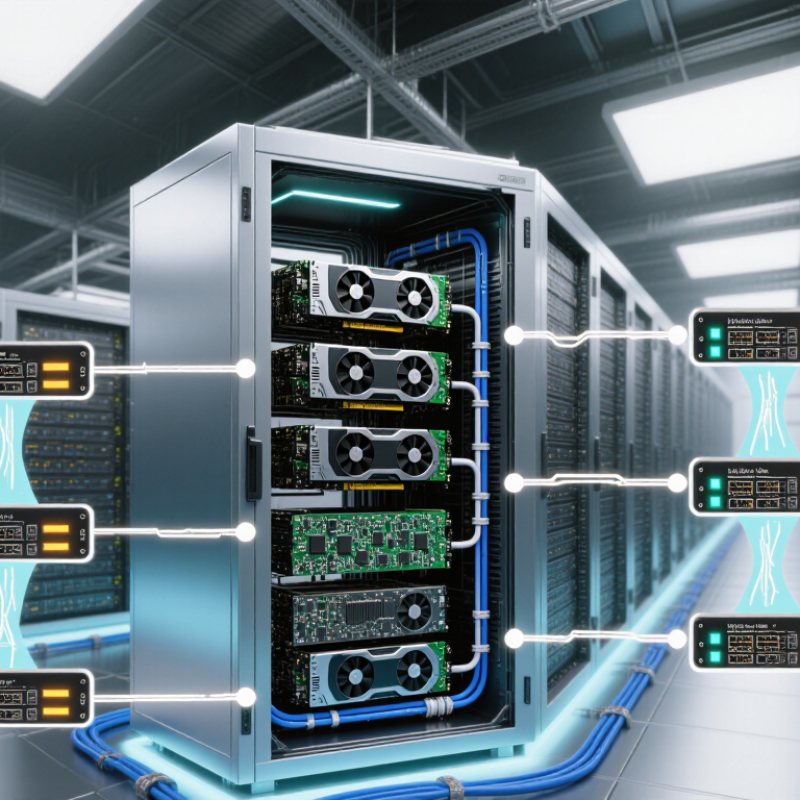
How to Find an AI Computing Server Manufacturer in 2026?

Define GPU, CPU, Memory, and Network Needs for Your AI Workload

How to Find an AI Computing Server Manufacturer in 2026?

Define the workload before contacting a server manufacturer. Training large models needs many GPUs, high memory bandwidth, and fast GPU-to-GPU communication. Inference may need fewer GPUs, but predictable latency and sufficient video memory matter more.

Stanford’s AI Index 2025 reports that notable model training compute has doubled approximately every five months. Your capacity plan can become outdated quickly. Test with real batch sizes, sequence lengths, and daily request volumes.

Do not size GPUs alone. Record CPU cores, memory capacity, storage speed, and network throughput. A CPU with too few cores can leave expensive GPUs waiting for data. Limited system memory may force slow data swapping.

For distributed training, measure collective communication, not only port speed. A practical test should show tokens per second, job completion time, GPU utilization, and failure recovery. Small details matter.

Electricity matters too. The International Energy Agency estimates that data center electricity use reached about 415 TWh in 2024 and could exceed 945 TWh by 2030.

Ask manufacturers for sustained power, cooling requirements, rack density, and acoustic limits. Request independent benchmark evidence under your software stack. A polished brochure is not proof.

I have seen theoretical throughput hide poor network scaling. That mistake is expensive. Evaluate warranty response, spare-part availability, firmware control, and upgrade paths before signing a purchase agreement.

Screen Manufacturers Supporting NVIDIA H200 or AMD MI300X-Class GPUs

Finding an AI computing server manufacturer in 2026 requires more than comparing processor prices.

Focus on suppliers that support H200-class or MI300X-class accelerators. Ask for the exact GPU configuration, memory capacity, interconnect design, and rack power requirements. Ask for proof.

A reliable manufacturer should provide performance records from workloads similar to yours. Request tests for model training, inference, data loading, and multi-GPU communication.

A polished benchmark is not enough. Check whether the test used realistic batch sizes, cooling conditions, and software versions.

Thermal management deserves close attention. Inspect airflow paths, fan redundancy, liquid-cooling options, and throttling behavior under sustained workloads. Small details matter.

Review the service agreement before placing an order. It should define replacement times, spare-part availability, firmware support, and remote diagnostic procedures.

Confirm compatibility with your preferred operating environment and orchestration tools. Security controls also need evidence, including access management and secure update practices.

I would request a sample acceptance test and run it before full deployment.

This step may slow procurement. It can prevent expensive surprises.

Some manufacturers communicate well during sales but respond slowly after delivery, which is a risk worth testing early. Evaluate documentation quality, engineering access, and references from customers operating comparable GPU clusters.

Compare Verified Training Results Using MLPerf Benchmark Data

In 2026, an AI computing server manufacturer should be judged by reproducible training evidence, not brochure throughput. MLPerf Training reports time to reach a required accuracy target across workloads such as ResNet, BERT, GPT-style language models, recommendation, and diffusion. Use the MLCommons MLPerf Training v4.1 submission database as a verification checkpoint. Compare identical workloads, software divisions, accelerator counts, precisions, and system scales. A lower time matters only when those fields match. Ask for the full submission ID, power assumptions, cooling design, and firmware version. Small configuration changes can distort comparisons.

Energy is not a footnote. The International Energy Agency estimated that data centers used about 460 TWh globally in 2022 and may exceed 1,000 TWh by 2026.

A supplier that wins a benchmark but needs impractical power may fail your deployment test. Request a pilot using your data pipeline, checkpoint schedule, and network topology. Measure time-to-target, failed runs, cooling headroom, and service response.

MLPerf is strong for standardized comparison, but it cannot reproduce every customer workload. I would avoid selecting the fastest listed system automatically. That shortcut is tempting. It can be wrong. A credible manufacturer should explain weaker results, publish repeatable evidence, and let engineers inspect the configuration before purchase.

Assess Power and Cooling Efficiency Against the 1.58 PUE Industry Average

How to Find an AI Computing Server Manufacturer in 2026?

Power and cooling efficiency should be tested before choosing an AI server manufacturer. The Uptime Institute’s Global Data Center Survey 2023 reported an average Power Usage Effectiveness (PUE) of 1.58. A supplier operating near this figure may be ordinary, not efficient. Ask for measured PUE data from comparable AI deployments, not only laboratory results.

Request rack-level power readings at 30%, 60%, and 100% utilization. AI accelerators often create sharp heat loads during training. The cooling design must handle these peaks without excessive fan or pump energy. Check inlet temperatures, airflow paths, liquid-cooling capacity, and failure responses. ASHRAE thermal guidance can help verify whether equipment remains within recommended operating ranges.

The International Energy Agency’s Electricity 2024 report expects data-center electricity demand to exceed 1,000 TWh by 2026 under its base scenario. That projection makes efficiency evidence more important. However, PUE alone can mislead. It excludes computing output and may improve during mild weather. I would also compare performance per training workload, water consumption, and power quality.

Ask for twelve months of utility and environmental records where possible. Independent verification adds credibility. Some documents may be incomplete. That is a warning, not a minor inconvenience. A practical site visit should include thermal imaging, meter checks, and interviews with operations engineers. The best manufacturer can explain poor readings, not hide them.

How to Find an AI Computing Server Manufacturer in 2026? - Assess Power and Cooling Efficiency Against the 1.58 PUE Industry Average

Assessment Dimension Verified Reference or Benchmark What to Request from a Manufacturer Evaluation Guidance
Overall Data-Center Efficiency PUE = Total Facility Energy ÷ IT Equipment Energy. Use 1.58 as the comparison benchmark specified in the title. Measured PUE at representative operating loads, including seasonal readings and the measurement boundary. A lower PUE indicates that less supporting energy is used for cooling, power distribution, lighting, and other infrastructure.
Server Power Supply Efficiency 80 PLUS Titanium power supplies are rated for up to 96% efficiency at 50% load when tested on 230 V input. Power-supply efficiency curves at 10%, 20%, 50%, and 100% load, plus redundancy configuration. Prefer a configuration that maintains high efficiency at the expected AI workload, not only at the peak rating.
Rack Power Density Traditional air-cooled racks commonly operate below approximately 20 kW per rack, while high-density AI deployments can exceed 30 kW per rack. Continuous and peak rack power, power distribution design, breaker ratings, and derating assumptions. Confirm that the proposed facility can support the required density without relying on unsafe or temporary power limits.
Cooling Method Air cooling, direct-to-chip liquid cooling, and rear-door heat exchangers are established approaches; suitability depends on heat load and facility design. Cooling architecture, supported heat load per rack, coolant requirements, leak detection, and service procedures. For high-density AI systems, compare total facility energy rather than evaluating the server cooling method in isolation.
Server Inlet Temperature ASHRAE recommended inlet temperature range for common data-center equipment is 18–27 °C. Validated operating temperature range, thermal-throttling limits, fan-speed behavior, and test conditions. A design that operates reliably within the recommended range can reduce excessive cooling and improve equipment life.
Cooling Water Efficiency WUE = Annual Site Water Usage ÷ IT Equipment Energy, expressed in litres per kWh. Projected WUE, water source, treatment requirements, discharge process, and operating assumptions. Consider WUE together with PUE because water-saving cooling designs may have different electricity requirements.
Power Usage Measurement Accurate assessment requires separate measurement of IT load and total facility load. Meter locations, sampling interval, accuracy class, reporting dashboard, and historical load data. Reject efficiency claims that do not clearly define the measurement boundary or operating load.
Workload Efficiency Useful metrics include performance per watt, throughput per kWh, and energy used per completed training or inference task. Benchmark results using defined models, batch sizes, precision formats, utilization levels, and software versions. Compare equivalent workloads; peak accelerator performance alone does not represent operating efficiency.
Thermal Management at Partial Load AI workloads may vary significantly over time, so idle and partial-load power can materially affect annual energy consumption. Power and temperature data at 10%, 25%, 50%, 75%, and 100% utilization. Prefer systems that avoid disproportionately high fan, pump, and power-conversion losses during lower utilization.
Reliability and Maintainability Redundant power paths, hot-serviceable components, temperature monitoring, and preventive maintenance reduce operational risk. Failure-mode analysis, component replacement procedures, spare-parts policy, and service-level commitments. Assess efficiency together with uptime requirements; the lowest energy use is not useful if serviceability is inadequate.
Evidence Quality Comparable results should be supported by repeatable tests, defined instrumentation, and documented operating conditions. Independent test reports, raw measurement data, test configuration, ambient conditions, and calculation methodology. Give higher scores to transparent, independently verifiable measurements rather than unqualified efficiency percentages.
Calculation reference: PUE = Total Facility Energy ÷ IT Equipment Energy. A PUE of 1.58 means that every 1.00 kWh consumed by IT equipment is associated with 0.58 kWh used by supporting facility infrastructure.

Audit ISO Certifications, Warranty Terms, Lead Times, and Service SLAs

How to Find an AI Computing Server Manufacturer in 2026?

When evaluating an AI computing server manufacturer, inspect ISO certificates instead of trusting website badges. Ask for current documents, certificate numbers, covered facilities, and audit dates. Confirm that the certification scope includes design, assembly, testing, or after-sales support. A certificate for an unrelated office proves little. Request evidence of corrective actions from recent audits. This small step often reveals how seriously a supplier controls quality.

Warranty terms deserve equal attention. Check coverage for accelerators, memory, power supplies, and cooling systems separately. Ask who pays shipping, labor, diagnosis, and replacement costs. Clarify whether firmware changes affect warranty coverage. In my procurement experience, vague exclusions created more delays than hardware failures. That was expensive. Require written DOA procedures, response contacts, repair targets, and escalation rules before issuing a purchase order.

Lead times should appear by configuration, not as one attractive number. A system needing imported processors, high-capacity memory, or liquid cooling may require additional weeks. Ask for production milestones, buffer stock, and shipment tracking. Then examine the service SLA carefully. It should define acknowledgement time, remote diagnosis, onsite arrival, spare-parts availability, and resolution targets. Test the support channel with technical questions before signing. A fast reply from sales is not proof of engineering support. I still leave room for uncertainty, because factory estimates can change after component allocation.

FAQS

What should I verify before choosing an AI server manufacturer?

Request the exact GPU count, memory capacity, interconnect design, and rack power requirements. Ask for written proof. Avoid relying on attractive processor prices alone.

Which performance tests should a manufacturer provide?

Request tests covering model training, inference, data loading, and multi-GPU communication. Check batch sizes, cooling conditions, and software versions. Polished benchmarks can mislead.

How can I evaluate thermal management?

Inspect airflow paths, fan redundancy, liquid-cooling options, and throttling during sustained workloads. Ask for temperature logs under continuous operation. Small details matter.

What should a sample acceptance test include?

Test the delivered configuration before full deployment. Include workload speed, memory stability, cooling behavior, and communication between accelerators. It may slow procurement. That is sometimes worthwhile.

How should I review ISO certifications?

Request current certificates, certificate numbers, covered facilities, and audit dates. Confirm coverage for design, assembly, testing, or support. An unrelated office certificate proves little.

Which warranty details require careful attention?

Check separate coverage for accelerators, memory, power supplies, and cooling systems. Clarify shipping, labor, diagnosis, and replacement costs. Require written DOA procedures and escalation contacts.

How should I judge production lead times?

Ask for lead times by configuration, not one general estimate. Imported processors, large memory, and liquid cooling may add weeks. Factory estimates can change.

What should a service agreement and SLA define?

Require acknowledgement time, remote diagnosis, onsite arrival, spare-part availability, firmware support, and resolution targets. Test technical support before signing. Sales speed is not engineering proof.

Conclusion

Choosing the right ai computing server manufacturer in 2026 begins with a clear understanding of your workload. Define the required GPU or accelerator capacity, CPU performance, memory bandwidth, storage, and network throughput for model training, inference, or data processing. Then shortlist manufacturers that support current high-end accelerator platforms and can provide verified training performance through independent MLPerf benchmark results. These results help compare real-world efficiency, scalability, and time-to-solution rather than relying only on advertised specifications.

Power, cooling, and long-term operating costs are equally important. Evaluate each system’s efficiency against the industry-average PUE of 1.58, while reviewing rack density, thermal design, and facility compatibility. Before making a decision, audit relevant ISO certifications, warranty coverage, replacement procedures, delivery lead times, and service-level agreements. A dependable manufacturer should offer transparent documentation, predictable support, and a configuration that balances performance, reliability, energy consumption, and total ownership cost.

Mason

Mason

Mason is a seasoned marketing professional with a deep expertise in the company's offerings and a passion for driving brand awareness. With a strong background in digital marketing strategies, he has an innate ability to connect with diverse audiences and effectively communicate product benefits.......