| GPU Compatibility |
Typical GPU capacity |
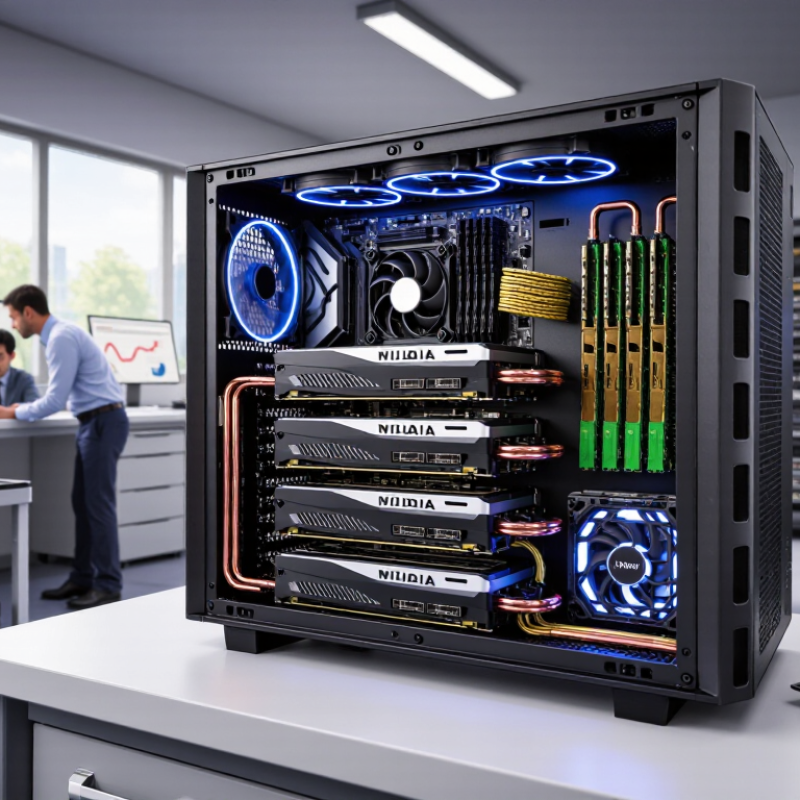
1 full-height, full-length dual-slot GPU |
2–4 full-height, full-length GPUs |
4–8 GPUs, subject to chassis spacing and thermal design |
| GPU Compatibility |
PCI Express interface |
At least one PCIe x16 slot with adequate physical clearance |
Multiple PCIe x16 slots; verify whether slots operate at x16, x8, or shared bandwidth |
PCIe switch or multi-root architecture may be required for several accelerators |
| GPU Compatibility |
PCIe generation |
PCIe 4.0 is suitable for many general-purpose workloads |
PCIe 4.0 or PCIe 5.0, depending on accelerator and host platform |
PCIe 5.0 can provide up to approximately 63 GB/s per direction on an x16 link |
| GPU Compatibility |
GPU physical fit |
Confirm card length, height, slot width, auxiliary power connector position, and airflow direction |
Allow sufficient spacing between cards to reduce heat recirculation |
Use a validated GPU carrier, riser, or tray design rather than relying only on motherboard slot layout |
| GPU Compatibility |
GPU power envelope |
Plan for the GPU board power rating plus CPU, memory, storage, fans, and transient headroom |
A 4-GPU system with 300 W cards can require at least 1,200 W for GPUs alone |
An 8-GPU system with 300 W cards can require at least 2,400 W for GPUs alone; redundant high-capacity power is usually necessary |
| GPU Compatibility |
Software and firmware validation |
Check operating-system support, driver support, virtualization requirements, and BIOS compatibility |
Validate multi-GPU enumeration, peer-to-peer communication, and workload-specific libraries |
Require a documented firmware, driver, kernel, and accelerator validation matrix before deployment |
| Server Architecture |
CPU and memory topology |
Single-socket platform with enough PCIe lanes for one GPU and storage devices |
Single- or dual-socket platform; map each GPU to the nearest CPU NUMA node |
Dual-socket or dedicated accelerator platform; confirm lane allocation and NUMA locality for every GPU |
| Server Architecture |
CPU-to-GPU connectivity |
Direct CPU-to-GPU PCIe connection is generally simple to deploy and troubleshoot |
Review the topology diagram to identify direct, switched, and cross-socket paths |
Choose a platform with a topology optimized for GPU peer traffic, collective communication, or accelerator fabrics |
| Server Architecture |
Memory capacity and bandwidth |
Select memory based on model size, preprocessing, virtualization, and host-side data caching |
Use balanced memory population across channels; avoid filling only a subset of channels |
Prioritize high memory bandwidth and sufficient capacity for datasets, orchestration, and multiple concurrent jobs |
| Server Architecture |
Cooling design |
Front-to-back airflow with a clear intake path is usually adequate for one moderate-power GPU |
Use high-static-pressure fans, blanking panels, and sufficient rack airflow for multiple GPUs |
Consider chassis-level thermal validation, liquid cooling, or facility-level cooling limits for sustained high-density loads |
| Server Architecture |
Power delivery and redundancy |
Size the PSU for continuous load plus transient margin; single or redundant PSU options may be practical |
Use redundant hot-swappable PSUs when uptime and serviceability are important |
Validate total circuit capacity, PSU sharing, connector ratings, and independent power domains |
| Expansion Options |
Storage expansion |
One or more NVMe drives for the operating system, cache, and local datasets |
Multiple NVMe drives with dedicated PCIe lanes for higher scratch and checkpoint throughput |
Front-accessible NVMe bays, hot-swap support, and separate boot, cache, and data tiers |
| Expansion Options |
Network expansion |
One high-speed network adapter is often sufficient for standalone workloads |
Add a faster adapter when datasets or checkpoints are served from shared storage |
Plan dedicated high-bandwidth, low-latency networking for distributed training or clustered inference |
| Expansion Options |
Future GPU upgrades |
Leave physical clearance, auxiliary power capacity, and PSU headroom for a higher-power replacement |
Reserve PCIe lanes and cooling capacity for additional or wider GPUs |
Confirm that the chassis, risers, power distribution, firmware, and cooling system support the planned upgrade path |
| Expansion Options |
Serviceability |
Tool-less access and clearly labeled cabling reduce maintenance time |
Prefer hot-swappable drives, redundant fans, and accessible GPU retention mechanisms |
Use modular GPU trays, replaceable risers, redundant power, and documented field-service procedures |
| Builder Selection |
Evidence to request before purchase |
Minimum
Mechanical compatibility drawing, power budget, supported operating systems, and thermal specifications
|
Recommended
PCIe topology diagram, validated GPU list, airflow test results, PSU redundancy plan, and expansion roadmap
|
Essential
Full system validation report, GPU-to-CPU affinity map, sustained-load thermal data, firmware matrix, and facility power requirements
|
| Total Cost of Ownership |
What to compare beyond the purchase price |
Energy consumption, warranty coverage, replacement parts, remote management, and expected workload utilization |
Cooling and power costs, storage expansion, downtime risk, and service response time |
Rack density, power infrastructure, liquid-cooling requirements, software support, and multi-year upgrade costs |
| Selection Rule |
Best fit |
✓ Development, visualization, light inference, and single-user workloads |
✓ Shared research, machine learning, simulation, and multi-user inference |
✓ Large-scale training, dense inference, HPC acceleration, and clustered workloads |
 Zentraix